世界第一等
Exclusive: China's maritime court settles Strait of Hormuz vessel collision dispute as foreign shipowners turn to Chinese law_我的网站

A | ■ 记者 张蜜
“警察同志,有个小姑娘正在机动车道上走,我劝她也不听,这太危险了,你们过来看看吧。

B |
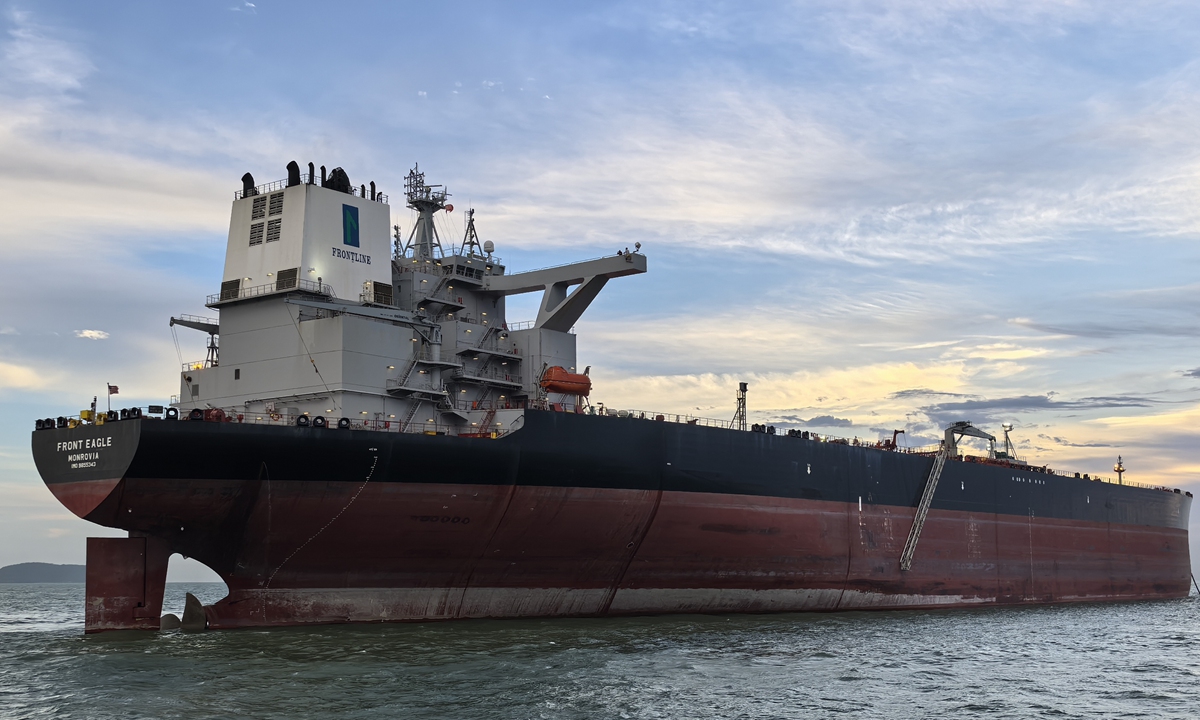
Liberia-flagged vessel Front Eagle Photo: Courtesy of China's Supreme People's Court Guangzhou Maritime Court recently successfully mediated a 180 million yuan ($25 million) dispute arising from a collision between two oil tankers in waters near the Strait of Hormuz, with both parties agreeing to apply Chinese law and submit their dispute to the Chinese court, the Global Times learned from the court on Sunday.
In 2025, two crude oil tankers collided at the eastern entrance to the Strait of Hormuz, 24 nautical miles off Fujairah, United Arab Emirates, media reported.
Owned by oil tanker operator Frontline, the Liberia-flagged vessel
Front Eagle collided with the Antigua and Barbuda-flagged vessel
Adalynn on the morning of June 17, 2025.
The
Adalynn was damaged in the fire. While the
Front Eagle was undergoing repairs in Shenzhen, South China's Guangdong Province, Global Shipping Holding Ltd., which owns the Adalynn, applied to Guangzhou Maritime Court for its arrest. Frontline provided a cash security of 203 million yuan to release the arrest and applied to establish a limitation fund for maritime claims.
The court approved the application and allowed Frontline to establish the limitation fund, setting the amount of the fund at 168 million yuan.
Guangzhou Maritime Court held four pretrial conferences on October 11, 2025, January 12, May 6 and July 13, 2026 to complete preparations for evidence examination, technical investigations and reported the relevant pretrial arrangements to the provincial high court, the Global Times learned from the court.
The court held a public hearing for the case on July 14, 2026.
No government agency had conducted an investigation into the collision, and no official findings were issued after the accident. Taking into account the unique burden-of-proof challenges in maritime collision disputes, Guangzhou Maritime Court took measures to preserve key evidence when handling the vessel arrest, including navigation logs, AIS data, voyage data recorder (VDR) records and CCTV footage, the court told the Global Times in a statement on Sunday.
Under a process that involves exchanging evidence inventories, sealing materials simultaneously and jointly reviewing them after evidence submissions, the court helped ensure the authenticity of critical records and laid the groundwork for determining the facts of the case.
As the two sides and their respective maritime experts reached sharply different conclusions over liability, the court introduced a maritime technical investigator mechanism, with the consent of both parties, allowing technical experts to participate throughout the proceedings. Drawing on the preserved evidence, investigators reconstructed the collision, assessed the vessels' encounter situation and clarified the parties' respective responsibilities.
Following the hearing, the court facilitated mediation, and the two parties reached a settlement agreement on July 27, 2026. On July 31, the court organized the distribution of the maritime liability limitation fund among creditors involved in the foreign vessel collision dispute and related charter-party disputes.
Representatives of the
Adalynn traveled from overseas to the court to present a letter of appreciation and a commemorative banner in recognition of the court's efforts, according to the court statement.
After the Guangzhou Maritime Court accepted the case, both parties agreed to apply Chinese law to establish a maritime liability limitation fund and resolve their substantive dispute, breaking away from the long-standing reliance of international shipping disputes on European and US courts and legal systems.
Choice of justice Bilov Viacheslav, a representative of Global Shipping Holding Ltd., told the Global Times that the main reason they chose a Chinese court to mediate the case is that "we want absolutely fair, unbiased approach to this issue. Because nowadays in this world, there are some countries which believe that they are authorized to give instruction to all others, which definitely is having influence on the decisions of the judge on the approach to the case."
Viacheslav gave the Chinese court's handling of the case a five-star rating, saying he had expected the dispute to take at least three years to resolve, but the Chinese court settled it within just one year. He also praised the judges and lawyers for their commitment to advancing the case throughout the proceedings.
"The judges and lawyers worked to advance the case with the same level of commitment as I did, even though the case directly concerned my own interests. This left a deep impression on me about litigation in China," Viacheslav said.
The case involved two foreign parties and a collision that occurred near the Strait of Hormuz, with no direct connection to China or Guangzhou Maritime Court initially. The fact that the parties chose to seek vessel arrest in China and agreed to apply Chinese law demonstrates the credibility and appeal of China's maritime judicial system, Wu Guining, vice president of the Guangzhou Maritime Court, who served as the presiding judge of the case, told the Global Times.
The court also introduced a maritime technical investigator mechanism in the case, an innovation aimed at addressing complex technical issues arising from vessel collision accidents, Wu said, noting that through technical investigations, the court was able to establish the facts of the case more efficiently, highlighting the integration of professional maritime investigation capabilities with China's specialized maritime adjudication system.
The case demonstrates China's ability to handle major, complex and cross-border maritime disputes with professional expertise, Wu said.
The handling of the collision between the two vessels is just one example of how Chinese courts have been dealing with a growing number of foreign-related maritime cases in recent years.
The Global Times learned from China's Supreme People's Court (SPC) in October last year that over the past 40 years, Chinese courts have handled a total of 88,000 foreign-related maritime cases involving parties from 146 countries and regions.
At a lecture held by the SPC on Friday, Shen Hongyu, director of the Fourth Civil Division of the SPC, told the Global Times that in recent years, Chinese courts have become more influential in participating in and promoting global ocean governance reform. Maritime justice serves as an important instrument for practicing the vision of a maritime community with a shared future and for advancing the reform of the global ocean governance system.
。”7月5日9时28分,龙港公安分局双树乡派出所接到群众报警,称在龙港区通海大道北站方向发现1名女孩,当时路上过往车辆虽然不多,但车速普遍较快,容易造成交通事故。

C |
接到报警后,派出所教导员张浩和辅警周洋准备出警。此时,一旁工作的户籍女警陈玉娇听闻身处危险的是1名女孩,便迅速将手里的工作转交给其他同志,申请一同前往现场。

D | 3人到达现场后,只见女孩正在马路上大步向北走,手中还拿着一个装有小花的矿泉水瓶。

E | 陈玉娇立即下车,在确保安全的前提下,试图将女孩带到非机动车道上,然而,女孩并不接受她的帮助,反而执意往马路中间跑去。无奈之下,陈玉娇一边耐心劝解,一边紧紧贴着女孩的左侧,用自己的身体将女孩拦住,以防她冲向机动车道。
面对前来帮助的民辅警,女孩突然情绪激动地向北“逃跑”。此时,雷锋车队的队员徐达、赵金彪正巧驾车路过,见此情形,他们果断将女孩截停。陈玉娇趁机一把将女孩搂住,并轻声安抚:“姐姐是警察,别害怕!小妹妹,你叫什么名字?家是哪里的?”待女孩情绪稍稳定一些后,陈玉娇询问女孩相关信息,可女孩只是回答:“我要回家……”“你家在哪里?姐姐送你回家好不好?”面对女孩的答非所问,陈玉娇依然耐心询问。结果,女孩还是那句“我要回家……”说完便再次向前跑去。“你看你出那么多汗,休息一下吧……”听到陈玉娇的关心,女孩放慢了脚步。“你渴不渴,别害怕,姐姐送你回家……”在陈玉娇关切的话语下,女孩终于放下心中的戒备,不再“逃跑”。“你的花真漂亮,在哪儿摘的?想送给谁?”陈玉娇试图通过瓶里的小花,问出女孩是从哪里来的、经过了哪些地方以及其家人的名字。

F | 但可惜的是,女孩对自己的个人情况描述不清,无法提供有用信息。
随后,民警将女孩的照片和有关情况发到了工作群。陈玉娇则继续通过聊天的方式,努力获取女孩的有效信息。正巧,龙湾街派出所民警穆宣羽接到辖区群众周某某报警,称其女儿周某于当天8时许,从家中出走,一直未找到。穆宣羽将工作群中的女孩照片给周某某看,确认了该女孩正是周某。40分钟后,周某某赶到现场。看到女儿平安无事,他向民辅警及相关群众一一表示感谢。
陈玉娇担心女孩再次走失,决定亲自护送她回家。在回家的路上,她了解到女孩3年前因疾病导致大脑神经元异常。
当天下午,周某某一家带着写有“最美女警 护女平安 心系群众 为民解忧”的锦旗来到派出所,再次向所有参与救助的民辅警表达了深深的谢意。
Current article:http://u0fos.bomanglangsugangunxileba.cyou/list_277slga/4cbo8xm.html
Published on:06:52:27